Vision: Toward a New Model of Medicine
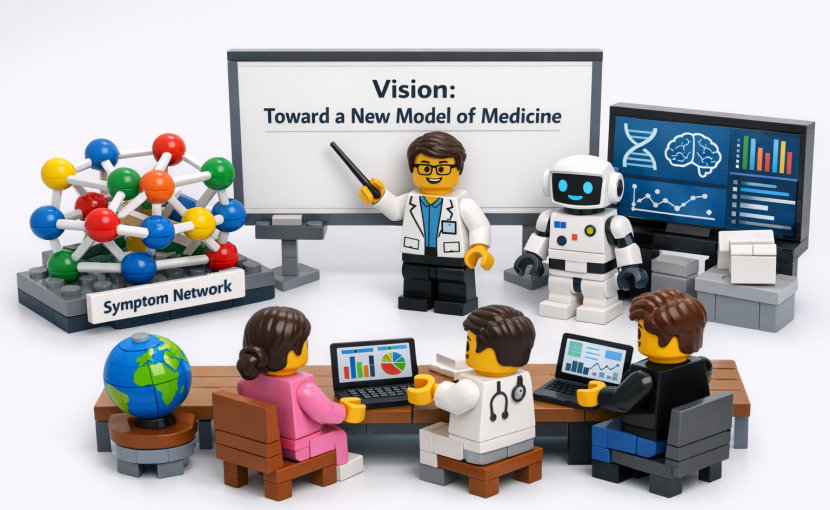
The ultimate goal of this work is to redefine the foundational ontology of clinical medicine and our systemic understanding of disease. We challenge the prevailing biomedical paradigm that treats symptoms as independent, fragmented variables. Instead, this research establishes that symptoms must be understood as structured, interdependent, and highly organized systems of discrete relational networks. In this framework, disease is not a collection of isolated events; rather, a disease process represents a decisive systemic transformation and reorganization of these underlying symptom structures. This pivotal perspective establishes a new, rigorous scientific discipline: Symptom Structure Science.
Future Directions
We will expand this robust conceptual and visual framework through four foundational pillars:
-
AI-Driven Clinical Architecture: Integration of advanced artificial intelligence (AI) and machine learning directly into high-dimensional clinical decision-making and precise therapeutic design.
-
High-Volume, Real-World Data Synthesis: Large-scale topological analysis of multidimensional, longitudinally followed patient-reported outcomes and massive real-world clinical datasets.
-
Cross-Domain Network Phenotyping: Rigorous mathematical comparison of reproducible symptom network structures and motives across diverse clinical domains, including urogynecological conditions, testosterone deficiency, and aging-related frailty.
-
Topological Predictive Modeling: Development of precise, individualized predictive models for optimal personalized treatment strategies, anchored in the underlying structure of a patient’s conditions.
These synergistic efforts decisively bridge the ontological and quantitative gaps between clinical vocabularies, advanced data science, and the rich qualitative spectrum of lived patient experience.
Collaboration and Opportunities
International collaboration is actively welcomed, particularly from institutions and individuals interested in shaping this emerging paradigm. Opportunities for robust partnership include:
-
Research Collaboration: Advancing network medicine, discrete mathematical modeling, and semantic data science.
-
Clinical Collaboration: Implementing data-driven therapeutic design in urogynecology, pelvic pain, and frailty.
-
Training and Mentorship: Integrated opportunities for students, fellows, and early-career clinicians–scientists.
This work is particularly suited for individuals with a powerful interest in translational medicine, high-order network medicine, data-driven clinical research, and the precise integration of AI into real-world medical practice.
Message
This work is built on the unwavering belief that clinical medicine must evolve. Clinical experience, data science, and patient narratives should not exist as separate conceptual or practical domains. They must be integrated into a single, unified, and evolving system. The future of precise, personalized, and truly patient-centered medicine lies in understanding not only diseases as disjointed biological signals, but the high-order topological structure of human suffering.