Redefining Symptom Ontology: The Case for Symptom Structure Science
[Problem Redefinition and Core Concept ]
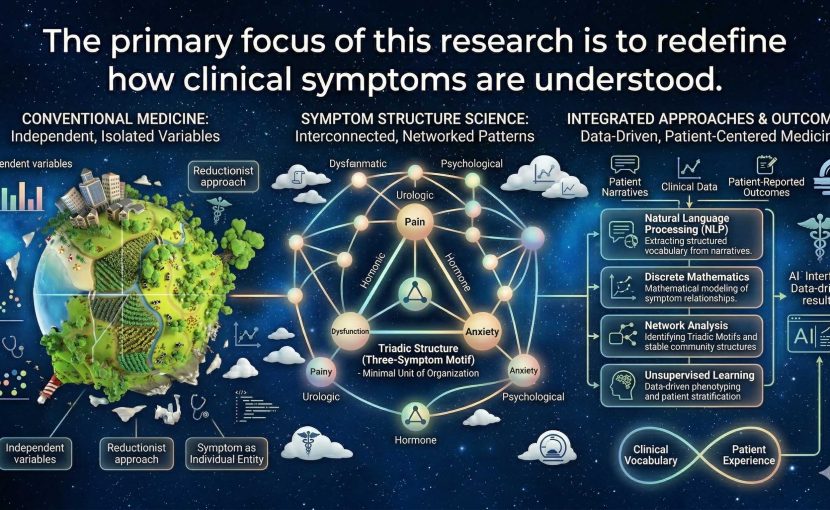
Conventional medicine predominantly conceptualizes clinical symptoms as independent, fragmented variables. While effective for localized diagnoses, this reductionist view often fails to capture the complexity of real-world clinical settings, where multiple symptoms rarely exist in isolation. Instead, they interact dynamically across physiological systems, comorbidities, and the patient’s lived experience. The present research addresses this fundamental ontological limitation by proposing that symptoms should be understood not as discrete individual entities, but as organized, interconnected, and dynamic relational systems. We introduce the triadic symptom motif, defined as a three-symptom triangular structure, as the foundational, minimal unit of symptom organization. This central concept reflects how symptoms interact non-linearly to form stable, high-order topological patterns. Within this framework, a disease process is interpreted not as a simple additive burden or collection of symptoms, but rather as a fundamental reorganization and systemic transformation of this entire structured symptom network. By analyzing symptom topology as relational structures, we can identify reproducible pattern motifs that underpin complex conditions, shifting our focus from fragmented parts to a systemic-level understanding of patient suffering.
[Methodology and Application Domains ]
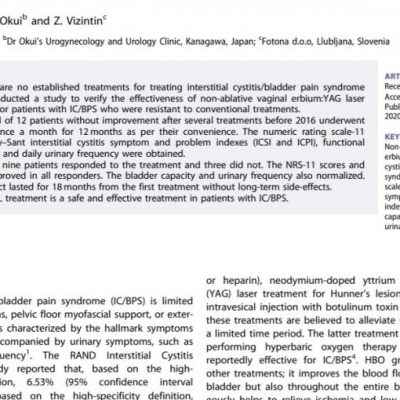
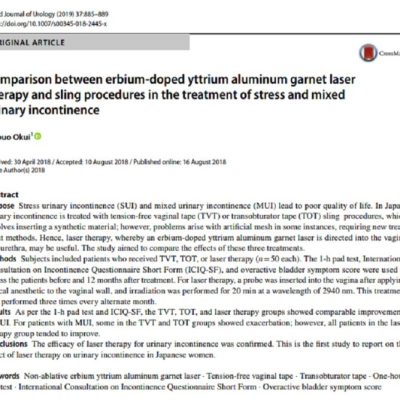
The methodological cornerstone of this approach is the rigorous integration of four synergistic analytical pillars: high-order network analysis, discrete mathematics (including graph theory and topology), and natural language processing (NLP) combined with unsupervised machine learning. This unique integration bridges the quantitative gap between structured clinical vocabulary and the rich, qualitative spectrum of real-world patient discourse. We utilize NLP to extract semantic networks from patient narratives and online health discourse, reinterpret these as structured discrete relational models, and identify stable community structures using unsupervised learning. A key innovation is using the triadic structure as a fundamental mathematical constraint for analyzing these networks. The reproducibility and utility of this structural approach are demonstrated across multiple diverse medical domains, including complex urogynecological conditions such as urinary incontinence and bladder pain syndrome, hormone-related conditions like testosterone deficiency and the systemic aging process, and psychosomatic disorders including clinical depression. This multi-domain consistency suggests that these higher-order triadic patterns may represent fundamental mathematical and physiological organizing principles in clinical medicine.
[Paradigmatic Vision and Final Goal]
The ultimate goal of this research is to establish a new framework for medical diagnosis and treatment interpretation: Symptom Structure Science. This entire conceptual and visual model conveys a decisive and definitive paradigmatic shift. We are moving reductionist medicine—which views symptoms as disjointed biological signals—toward a sophisticated system-level understanding of symptom structure. On the left side of this conceptual vision, traditional biomedical elements analyze organs independently. On the right, digital interfaces, artificial intelligence (AI), and visualized patient-physician interactions represent the precise integration of real-world narratives, providing previously unobserved structured clinical insight. The central triangular structure symbolizes the transformative shift enabled by integrating network mathematics and data-driven insights. By unifying clinical terminologies, objective data (biological levels, anatomical markers), and lived patient experiences into cohesive relational structures, Symptom Structure Science establishes a powerful new interface between mathematical precision and human suffering. This unifying framework enables a more accurate and nuanced data-driven interpretation of the true patient condition, supporting the fundamental transition toward precise, personalized, and truly patient-centered medicine.